Take the hardware off
Handles, locks, knockers and hinges where practical. Masking around door furniture takes longer than removing it, and the edge is never as clean.
Paint on brass or chrome is the single clearest sign of a rushed door, and it is almost impossible to correct neatly afterwards.
Prepare more than feels necessary
Wash the door down — front doors collect more grime than any other painted surface in a house. Then sand the whole face to key the existing coating, not just the damaged parts.
Fill dings and dents, sand flush, and spot prime any bare timber. On a weathered exterior door this preparation is genuinely most of the job.
Prime for what is underneath
Bare timber, previously oiled timber and old enamel all need different primers. Getting this wrong is why topcoats lift off doors a year later.
If you do not know what is on the door already, that is a good reason to ask someone rather than guess — especially on a pre-1970 Brisbane home where there may be several generations of coating.
Work the panels in order
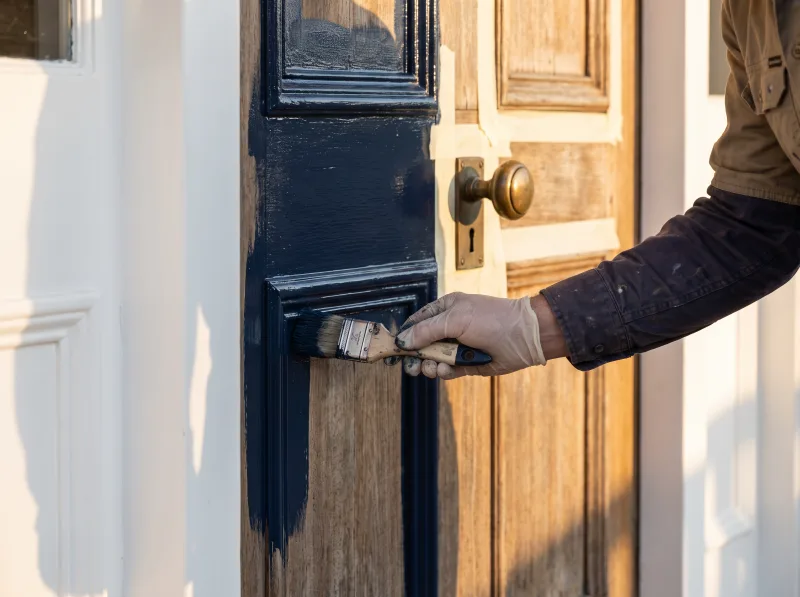
On a panelled door: the panels first, then the horizontal rails, then the vertical stiles. Following the construction of the door keeps the brush marks running the right way and stops build-up in the corners.
Do the edges too — particularly the top edge on an exterior door, which is the one everybody forgets and the one water sits on.
Lay it off and leave it alone
Enamel flows out as it dries. Load the brush, spread the paint, then lay off in one direction with light strokes and stop. Going back into paint that has started to set is what leaves brush marks.
Two coats with the full recoat time between them. A door rushed in one afternoon will look like it was, from the first morning the sun hits it.